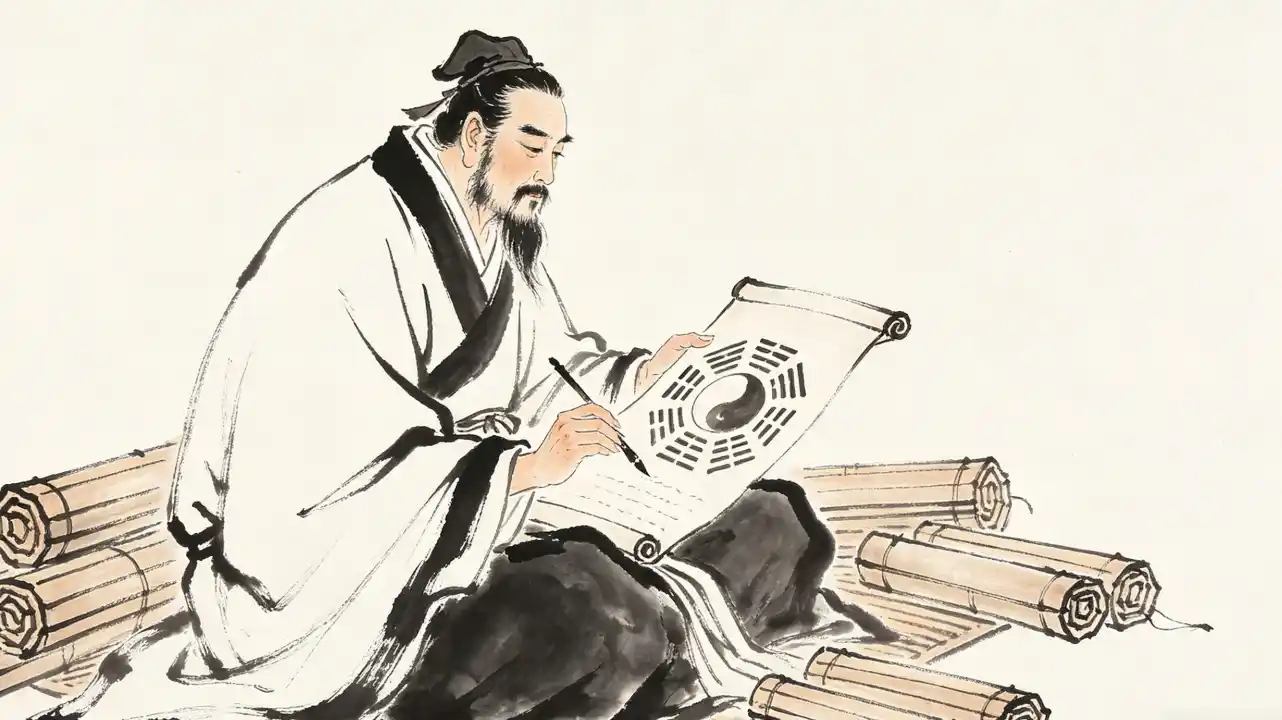
Confucius and I Ching: The Key Transformation from Divination to Philosophy
The encounter between Confucius and the I Ching was a milestone event in Chinese intellectual history. This relationship can be divided into three stages, completing a fundamental philosophical transformation.
First Stage: Late-Life Intellectual Turn
According to the Records of the Grand Historian, Confucius developed a strong interest in the I Ching in his later years, expressing “If I could have a few more years, studying the I Ching at fifty, I could avoid major mistakes.” During this period, he studied the I Ching so intensively that he “wore out the leather bindings three times.”
Second Stage: Creative Reinterpretation
The Appended Remarks (Xi Ci) records Confucius saying: “Writing does not fully express words, and words do not fully express ideas—so can the meaning of the sages never be seen?” In other words: writing may not exhaust what speech can convey, and speech may not exhaust what the heart truly intends; if so, would the deep meaning of the sages be beyond our grasp?
The text then answers: to convey what writing and language cannot exhaust, “the sages established images to exhaust meaning, set up hexagrams to exhaust the true and false of situations, attached texts to exhaust their words, changed and extended them to exhaust benefit, and roused and animated them to exhaust spirit.” That is: the sages drew hexagrams and established images to give full voice to meaning; they set hexagrams in place to map the range of situations and conduct in human life and the cosmos. After images and hexagrams came the appended texts, to spell out the subtle meanings; to follow change and seek thoroughness is to show the benefit of all things’ ceaseless generation; to rouse and move the process is to bring forth the spirit-like work of the Way’s endless creativity.
In this framework of “image—hexagram—text—change and extension—spiritualization,” hexagrams are not merely tools for divining good or ill but a symbolic system carrying the meaning of the sages. Confucius’s greatest contribution was precisely this “creative transformation” of the I Ching: he downplayed its purely divinatory function, emphasized instead “observing its virtue and righteousness,” and infused the ancient hexagram lines with new ethical and philosophical depth.
Third Stage: Establishment of Classical Status
Through the compilation and interpretation by Confucius and his disciples (the composition of Yi Zhuan), the I Ching evolved from a divination book into an important Confucian classic, establishing its lofty status as the “First of All Classics” in Chinese culture.
This transformation made the I Ching truly become the source of wisdom for the Chinese nation.