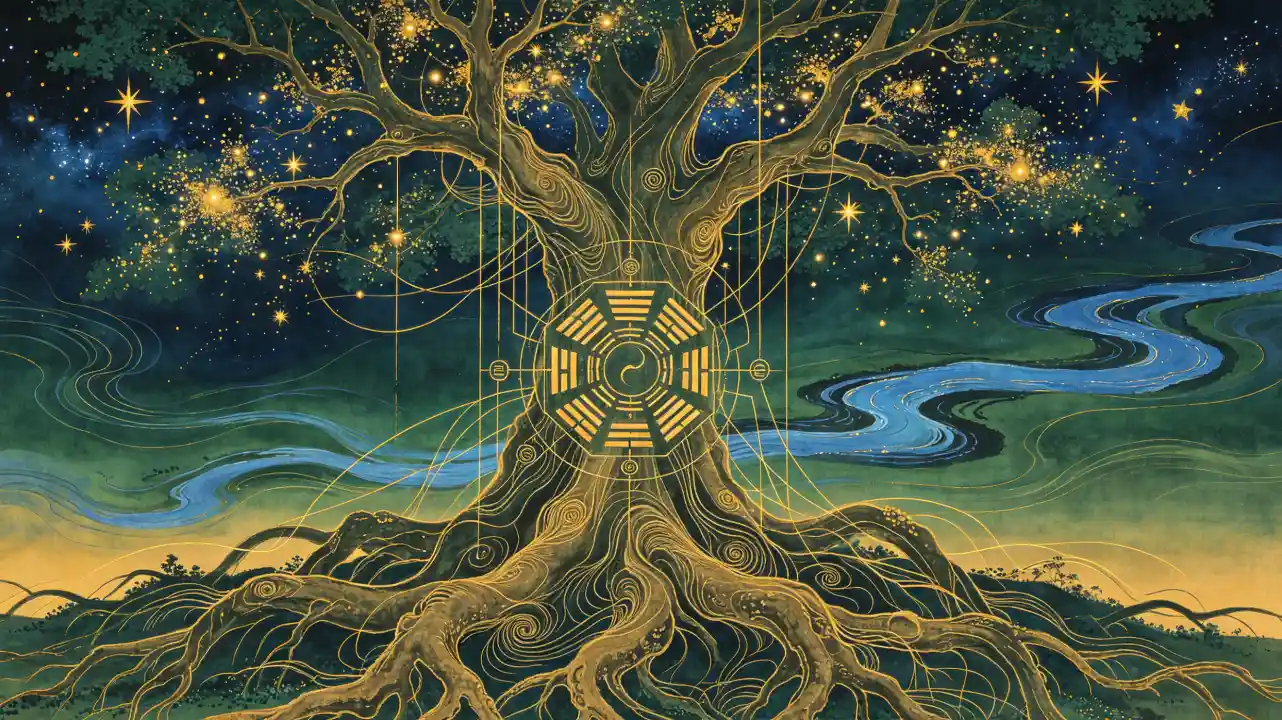
The Essence of Confucius's I Ching Philosophy: Virtue as Foundation and Unity of Heaven and Humanity
Confucius’s discourse on the I Ching, concentrated in the Yi Zhuan (Ten Wings), forms a distinctive philosophical system. Its core can be summarized in three progressive levels, moving from personal ethics to a complete vision of human existence within the cosmos.
Foundation Level: Virtue as the Basis
Confucius explicitly proposed replacing the primacy of divination with the primacy of virtue. He warned that “without constant virtue, one will bear shame” — meaning that those lacking enduring moral character find no real benefit even from auspicious hexagrams. For Confucius, a person of integrity who encounters a difficult situation will find more meaning in self-examination than in seeking a favorable prediction. He placed moral cultivation firmly above divination and fortune-seeking, shifting the entire purpose of consulting the I Ching from “what will happen to me?” toward “what kind of person am I becoming?”
Method Level: Observing Symbols to Cultivate Oneself
Confucius offered a practical method for engaging with the I Ching: “The superior person, when at rest, contemplates the images and studies the words; when active, contemplates the changes and studies the divinations.” This means that the I Ching should be a constant companion in both reflection and action. In quiet moments, we study the hexagram structures and ponder the texts; in moments of decision, we observe the dynamics of change and apply the principles we have absorbed. Through this cycle of study and application, we gradually refine our judgment and cultivate our character.
This approach transforms the I Ching from a book of mysteries into a training manual for wisdom. The hexagrams become tools for pattern recognition, and the line statements become guides for navigating complexity.
Highest Realm: Unity of Heaven and Humanity in Virtue
Confucius’s most profound contribution was connecting the laws of the cosmos with the spirit of human ethics. His vision finds its clearest expression in two lines that have shaped Chinese thought for two millennia:
“Heaven moves vigorously; the superior person strives continuously to strengthen themselves. Earth’s condition is receptive; the superior person carries things with great virtue.”
This is not merely a metaphor. In Confucius’s view, the same vital energy that drives the heavens and sustains the earth also flows through human life. To be virtuous is not to conform to arbitrary rules; it is to align oneself with the fundamental character of reality itself. The person who cultivates this alignment achieves a state where inner character and outer circumstance are no longer in conflict — what the tradition calls “the unity of heaven and humanity.”
For Confucius, this was the ultimate purpose of studying the I Ching: not to manipulate fate, but to so thoroughly embody wisdom and virtue that one naturally responds to whatever change may come.