KOSPI in One Year: Reading South Korea's Stock Market Through the I Ching's Fullness and Emptiness
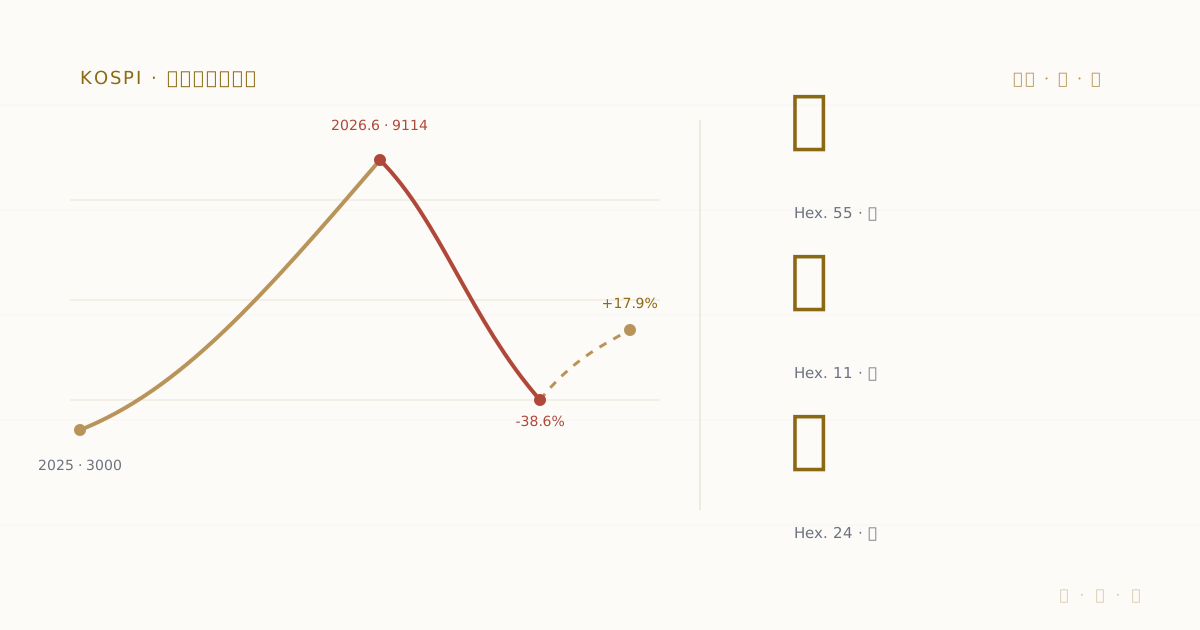
The Korea Composite Stock Price Index (KOSPI) has taken a route few predicted over the past year: past 3,000 in June 2025, past 4,000 in October, closing 2025 at 4,214. In 2026 it moved through 5,000, 6,000, and 8,000, first touching 9,000 intraday on June 18 and reaching an all-time high of 9,114.55 on June 22.
Then came the reversal. By July 30 the index was 38.63% below its peak, erasing about 2,877 trillion won of market value in 38 days — more than South Korea’s annual GDP. On July 31 it rebounded 17.91%, its largest one-day gain ever, to close at 6,595.45.
This story is almost a textbook version of what the I Ching calls yingxu (盈虛) — fullness and emptiness. The I Ching is not a tool for predicting index levels. It is a language for describing why things take the shape they do, and what to watch next.
Hexagram 55 (Feng, ䷶): The Sun at Noon Begins to Decline
Feng is abundance. Its Image says:
日中則昃,月盈則食,天地盈虛,與時消息,而況於人乎? When the sun reaches noon it declines; when the moon becomes full it wanes. Heaven and earth wax and wane with the times — how much more so for people?
Korea’s abundance came from a real industrial dividend: AI servers need high-bandwidth memory (HBM), supply is tight, and Samsung Electronics and SK hynix hold roughly 80-90% of next-generation HBM4 capacity. Their first-quarter profits were several times higher than a year earlier, in some cases dozens of times.
But the abundance had a structural problem. Samsung and SK hynix together account for more than 40% of KOSPI weight — by some counts more than half. Single-stock 2x leveraged ETFs launched in May added fuel, and trading in the two names plus their leveraged ETFs once exceeded 70% of total market turnover. The more concentrated the rally, the closer it is to noon; and the closer to noon, the more certain the decline.
Hexagram 2, First Line (Kun, ䷁): Treading on Frost; Hard Ice Will Come
The crash did not happen overnight. Kun’s first line says:
履霜,堅冰至。 Treading on frost, hard ice will come.
The Wenyan commentary adds: “非一朝一夕之故,其所由來者漸矣” — it was not the work of a single morning or evening; it came gradually. The signals were there: regulators greenlighting leveraged products in May, investors in their 20s and 30s making up about 62% of leveraged product buyers, retirement and long-term savings being withdrawn into the market, 37 trading halts and seven circuit breakers within a year, and an index concentrated in two companies.
Each sign alone was just frost. Together, they were hard ice.
Hexagram 11, Top Line (Tai, ䷊): The Wall Falls Back into the Moat
For the 38 days of the reversal, Tai’s top line gives a precise image:
城復於隍,勿用師。自邑告命,貞吝。 The wall falls back into the moat. Do not use an army. Announce orders from your own city; perseverance brings blame.
The wall was built as a defense; the higher it rose, the louder it fell. “Do not use an army” warns against fighting a reversed trend with brute force. The office worker in the news who borrowed five times to average down and ended up more than 50% underwater is a classic “use an army” case. Perseverance is not wrong, but persisting in the wrong position becomes stubbornness.
In mid-July the Bank of Korea raised rates, and regulators raised margin requirements and paused new products, hoping to cool the market — but the tightening triggered margin calls and a forced-liquidation spiral: about 2.6 trillion won of forced selling between May and July 29, and margin account balances down about 27.2 trillion won from the June peak.
Hexagram 60 (Jie, ䷻): Bitter Restraint Cannot Be Persevered In
Leverage is measurelessness; regulation is measure. The Image says:
節以制度,不傷財,不害民。 Regulate through institutions, so wealth is not harmed and people are not hurt.
Good institutions set limits in advance rather than fighting fires after the explosion. Here the restraint came late and bitter: leverage was opened in May, then tightened suddenly in June and July, and the liquidity contraction amplified the stampede. The judgment warns “苦節不可貞” — bitter restraint cannot be persevered in. Half-finished deleveraging becomes a new source of volatility.
Hexagram 24 (Fu, ䷗): Return — or Returning in Confusion?
The historic rally on July 31 can easily be read as return. Fu says “反覆其道,七日來復” — the way turns back; after seven days, return comes. Markets do cycle back; that is the rhythm. But Fu’s top line says:
迷復,凶,有災眚。 Returning in confusion brings misfortune and disaster.
To tell return from confused return, watch where the money is going: foreign investors were net buyers, institutions were still net sellers, and retail investors were still net buyers of the SK hynix leveraged ETF; margin financing had fallen only about 15% from its peak. If the return rests on repaired fundamentals and completed deleveraging, it is Fu. If it is people rushing to get their money back and releveraging, it is mi fu — return in confusion.
South Korea’s story this year is: nobody believed the frost, nobody wanted to leave at noon, nobody would admit the wall had fallen, and now everyone is waiting to see whether this is return or confused return. For an individual, the framework comes down to three questions: where are you in the cycle, where do you stand among the lines, and is your momentum borrowed or grown?
Want to go further with your own context? Open the app to explore chat and the hexagram library.