When War, El Nino, and Food Prices Meet: 'First Prepare, Then Eat' Through the I Ching
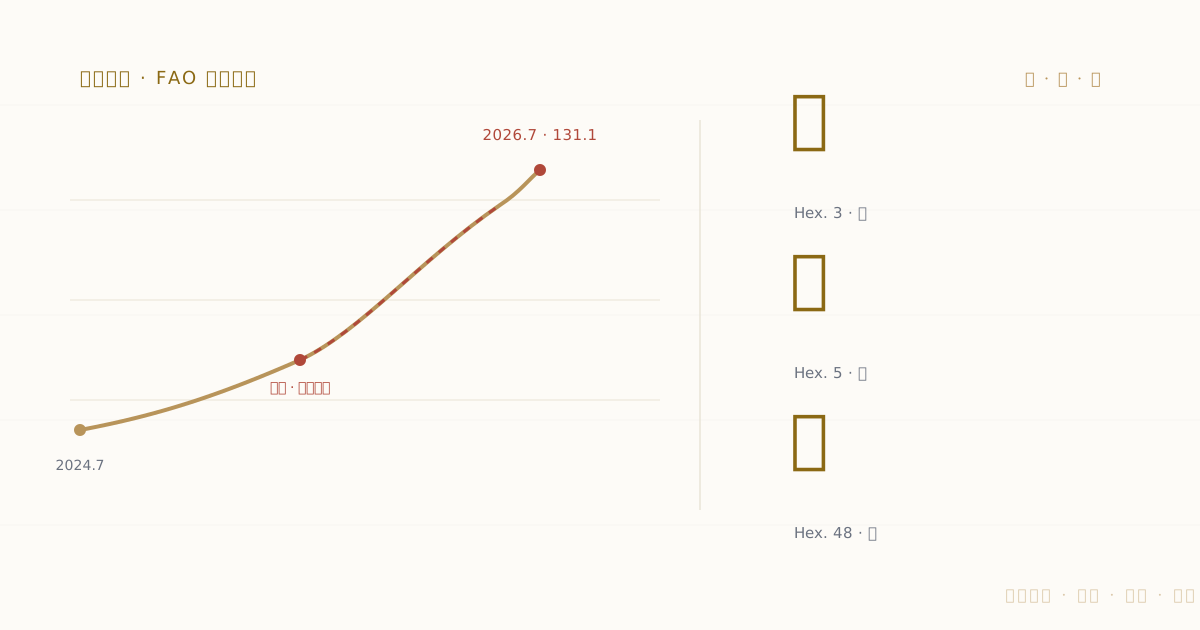
On August 5, 2026, the chief economist of the UN Food and Agriculture Organization (FAO) warned that the world may be entering a new food-price upcycle. In July, the FAO Food Price Index reached 131.1, a three-year high. War, extreme weather, and El Nino now appear in one frame: conflicts in Iran and Ukraine push up energy and fertilizer costs, while El Nino weighs on output in major growing regions.
This is not doomscrolling, and it is not the emotional forecast of an influencer. It is a set of checkable public numbers. The real question: when food prices start moving, what should ordinary people believe, do, and avoid doing? Three hexagrams break this into three layers.
Hexagram 3 (Tun, ䷂): Clouds and Thunder; the Superior Man Brings Order
Tun describes the difficulty of things beginning: hard and soft first meet, movement occurs within danger. Its judgment says:
屯:元亨,利貞。勿用有攸往,利建侯。 Difficulty at the Beginning works supreme success; perseverance furthers. Do not set forth blindly; it furthers one to appoint helpers.
“Do not set forth blindly” does not mean do not act. It means do not act without a plan. The Image adds:
雲雷,屯;君子以經綸。 Clouds and thunder: the image of Difficulty at the Beginning. Thus the superior man brings order out of confusion.
“經綸” originally meant sorting tangled threads; it extends to planning and weaving order. With food prices rising, the first step is not panic buying but taking stock: how long could your household supplies last? Where are the weak links in the nearby supply chain? How much of your spending is directly exposed to food prices? Turning worry into a checklist is “經綸”.
Hexagram 5 (Xu, ䷄): Waiting at the Border; Waiting on the Sand
Xu literally means waiting. Its Image says:
雲上於天,需;君子以飲食宴樂。 Clouds rise up to heaven: the image of Waiting. Thus the superior man feasts and is of good cheer.
The clouds have gathered, but the rain has not yet fallen. The more urgent the moment, the easier it is to make mistakes. Xu’s first line:
需於郊,利用恆,無咎。 Waiting at the border. It furthers one to remain constant. No blame.
Keep steady while the risk is still far away: no panic, no racing ahead. The second line goes further:
需於沙,小有言,終吉。 Waiting on the sand. There is some gossip. The end brings good fortune.
Closer to the water, you hear rumors, complaints, and the sound of hoarding. If your rhythm stays calm, the end is still good. Applied to food: normal consumption and monthly shopping are closer to Xu than stockpiling half a year at once. Waiting is not passivity; it is letting action keep pace with the times.
Hexagram 48 (Jing, ䷯): The Well Is Not the Village
The real question behind food prices is not one month’s number, but whether the supply system still works. Jing’s judgment says:
改邑不改井,無喪無得,往來井井。汔至亦未繘井,羸其瓶,凶。 The town may be changed, but the well cannot be changed. It neither decreases nor increases. People come and go and draw from the well. If they reach almost to the water and the rope fails, or the jug breaks, misfortune.
The village can move; the well stays. The well itself gains and loses nothing. Trouble usually appears at the last step: people arrive at the well, but the rope or the jar breaks. Today’s “well” for the global food system is ports, storage, fertilizer, energy, and logistics networks. War, El Nino, and trade restrictions all test whether these links can still meet demand at the last step. The Image says:
木上有水,井;君子以勞民勸相。 Wood over water: the image of the Well. Thus the superior man encourages people in their work and exhorts them to help one another.
For an individual, this is a reminder that what is truly scarce is often not a bag of rice, but order in information and trust. Instead of guessing prices, verify facts, build a small buffer, and exchange reliable information with the people around you.
A Three-Year High Does Not Mean No Food Tomorrow
The FAO’s 131.1 is a process signal, not a verdict. It tells us costs are transmitting, some growing regions are under pressure, and another wave of food inflation is possible by year-end. A rational reading comes down to three checks:
First, check the source. The FAO Food Price Index is a monthly public number, and war, El Nino, and energy prices are checkable variables. Any claim that turns “three-year high” directly into “food shortages are coming” is exaggerating certainty.
Second, follow the transmission chain. Food prices are shaped together by energy, fertilizer, transport, and climate. Transmission has order and strength; different countries and crops will be affected very differently. One index cannot summarize every table.
Third, focus on what you can control. At the household level: keep normal reserves, watch price signals, and do not be dragged into hoarding panic. At the social level: strengthen supply-chain diversity and infrastructure resilience.
The I Ching is not for calculating whether a food shortage will happen this year. It offers a different discipline: first bring order, then wait, and finally check whether the well is still open. In one sentence:
Prepare first, then eat in peace. Rationality is not coldness; it is turning worry into a checklist.
Want to go further with your own context? Open the app to explore chat and the hexagram library.