Penelope's Waiting: How to Keep Your Order When the Situation Is Not Yours to Control
The most powerful part of the Odyssey is not the hero’s return. It is how one person kept a home from falling apart while the hero was absent.
Odysseus was away from Ithaca for twenty years. After the war ended, he did not come back. The palace filled with suitors who consumed its wealth, pressured Penelope to remarry, and waited for the household to collapse. If she agreed, she risked losing the place her husband had left her. If she refused, she risked losing her room to act at all.
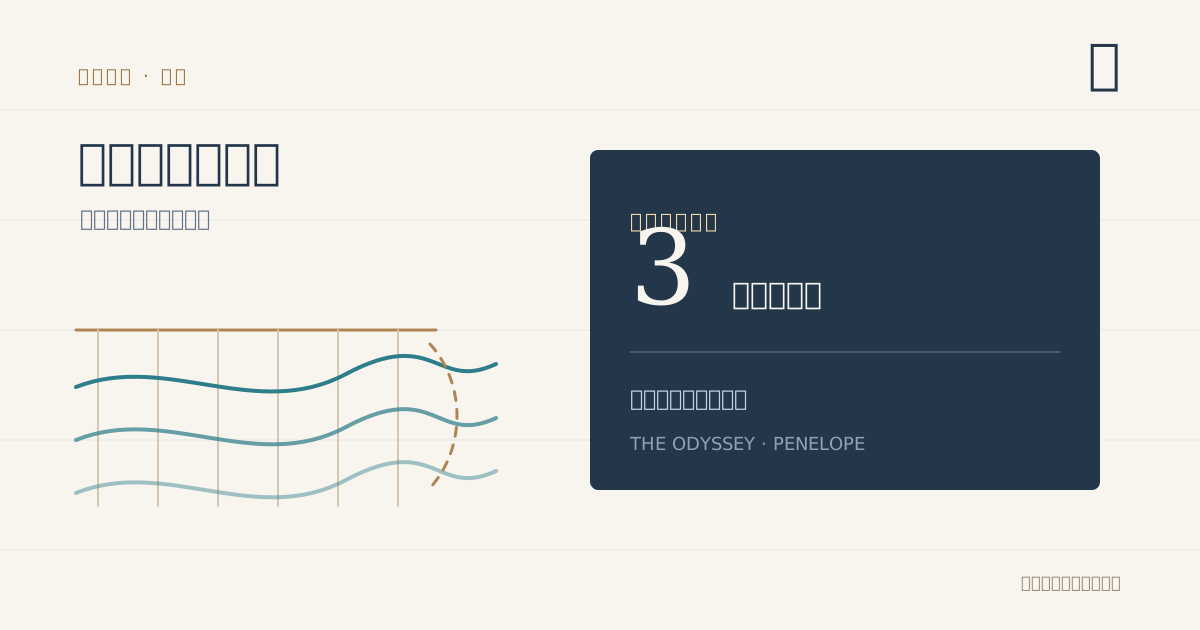
She did not confront a crowd head-on. She said: wait until I finish weaving a burial shroud for my father-in-law, and then I will decide. She wove by day and unraveled by night. A cloth that could never be finished bought her three years.
This is not a story about passive endurance. It asks a more precise question: when the external situation is not yours to decide, what can you still keep in order?
Line 2 Is Not an Instruction to Retreat
The second line of the Family hexagram says:
Six in the second place: She should not follow her own will. She should manage the affairs of the household. Perseverance brings good fortune. The Image says: The good fortune of the six in the second place comes from yielding and following the wind.
In its classical setting, “the affairs of the household” refers to food, internal order, and the daily work of keeping a family functioning. It is not merely a word about the kitchen. It is closer to what we might call systems stewardship: where resources come from, how they are distributed, who belongs to the household, and who confirms its identity and boundaries.
“She should not follow her own will” is also difficult to reduce to “do nothing.” The line sits in the central place of the inner trigram, a yin line in a yin position. It suggests that not every position is meant for outward conquest. Some positions create value by holding things together rather than making the loudest move.
That is Penelope’s situation. She cannot change the imbalance of power with a single confrontation, but she can still decide how the palace operates, how its wealth is delayed from disappearing, how the suitors are refused, and how her son and the household’s identity are protected. She does not leave her position. She turns it into a line of defense.
Why a Piece of Cloth Could Hold Back Three Years
The trick of the loom matters less than the time it creates.
In a direct conflict, Penelope is far weaker than the suitors. By giving them a deadline instead of a decision, she turns “you must choose now” into an ongoing negotiation. The cloth moves forward each day and back each night. Part of the time is taken back.
This is the modern meaning of “the affairs of the household”: you may not control which way the wind blows, but you can control the table, the ledger, the pace, and the boundary.
That is not abstract.
When work becomes unstable, you can control your cash flow, skill renewal, and readiness to leave. When a family relationship fractures, you can control communication rules, the stability of a child’s daily life, and your own limits. When markets become noisy, you can control your sources of information, your risk exposure, and how long you wait before deciding. The external problem has not disappeared, but you are no longer entirely passive.
Waiting is not handing your future to luck. It is spending time on the part that remains yours.
Why the Bed Is the Final Test
After the suitors are defeated, Penelope still does not accept the returned Odysseus at first sight. She asks for the marriage bed to be moved, then waits for him to explain how it was made.
One bedpost is a living olive tree rooted in the ground. The secret is not just a mark of identity. It is a shared history that only two people can know. She is not asking whether he looks like Odysseus. She is asking whether the relationship is still grounded in a fact that can be verified.
This changes the weight of the story. Penelope does not sustain twenty years on feeling alone. At the decisive moment, she still asks for evidence. First she uses procedural ambiguity to create time. Then she uses a shared, difficult-to-fake detail to verify the relationship. Reason and emotion do not cancel each other here. They check each other.
How to Use This Today
Put the second line back into modern life and ask three questions:
First, what can I actually control? Not every variable, but a few concrete boundaries: time, cash, information, sequence of action, and the worst outcome I can absorb.
Second, am I protecting a value, or only an old form? Penelope is not protecting the rule that a wife must wait at home. She is protecting identity, property order, and future options. If a rule today protects only its own form, it should be redesigned.
Third, what condition am I waiting for? Waiting without a trigger is postponement. A mature wait has an observation point, a time boundary, and a next action: what signal says continue, and what signal says change strategy.
The line says perseverance brings good fortune. Perseverance is not standing still. It is maintaining a just order under difficult conditions. Mature waiting does not hand you over to time. It keeps you working inside time.
The Odyssey is an ancient epic, and its relation to the Family hexagram is a cross-cultural analogy, not an equation between two worlds. But both raise a modern question:
When the situation is temporarily not yours, can you first keep your own order intact?
Want to go further with your own context? Open the app to explore chat and the hexagram library.