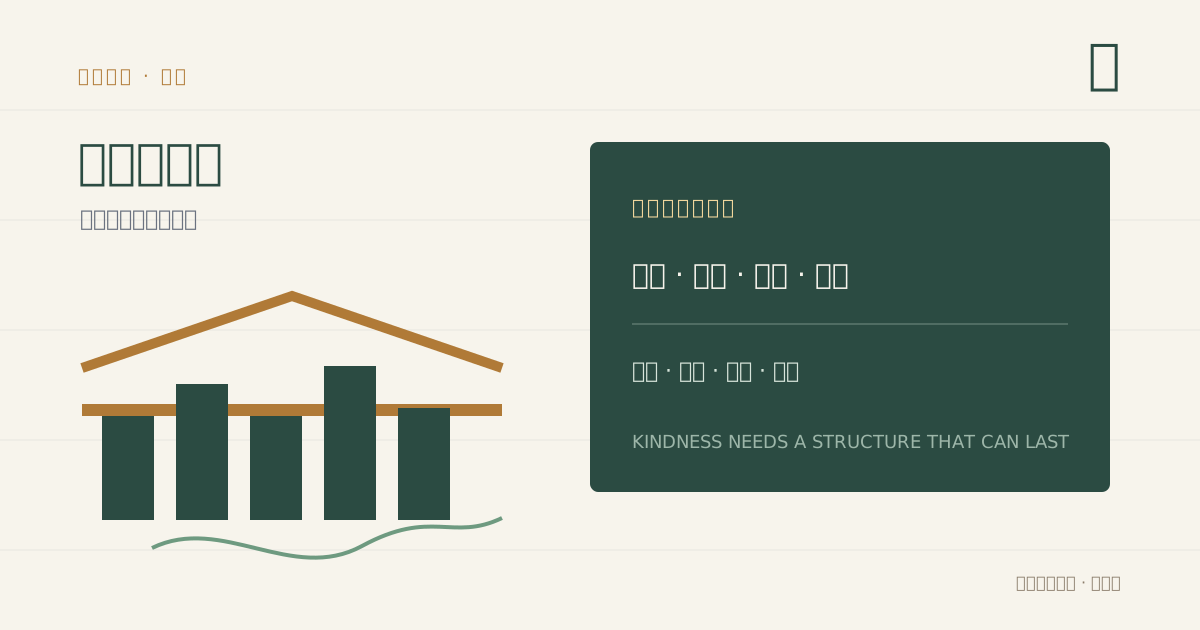
Fan Zhongyan's Charity Estate: When Goodwill Becomes an Institution, a Family Gains a Real Fallback
When a family encounters hardship, what is the most reliable support?
Is it the help of a kind person, or a set of rules that can keep working even when the founder is no longer present?
Fan Zhongyan was not a king. But the responsibility of the “great household head” discussed in the fifth line of the Family hexagram found a concrete expression in his work. In 1049, he established charitable fields in Suzhou. The following year, written rules were set down and the Fan clan charity estate began to operate.
The estate was not a one-time act of charity. It converted land rent into long-term income and wrote food, clothing, marriage, burial, and education into its scope of support. When a family member faced illness, a funeral, poverty, or the cost of study, there was a fallback that could be anticipated.
Line 5: A Family Is Not Only Governed; It Must Be Held in Mutual Care
The fifth line of the Family hexagram says:
Nine in the fifth place: The king approaches his family. Do not worry. Good fortune. The Image says: The good fortune of the king approaching his family comes from mutual love.
In traditional readings, the word rendered as “approaches” also carries the sense of arriving, reaching, or influencing through virtue. The fifth line occupies a place of honor, but the point is not merely authority. It is the ability to make a community truly cohere. The Image names the key: not forcing everyone together by command, but forming stable mutual care among members.
Fan Zhongyan was not a king. Connecting his charity estate with this line is a later analogy, not an attempt to place him in a royal office. What the two share is scale. When a person gains capacity, does he protect only his immediate household, or extend responsibility to a larger community?
The Remarkable Part Is That Goodwill Can Be Inherited
Goodwill easily depends on an individual. While one person lives, has money, and retains the energy to help, relief can continue. When that person leaves, the work may stop.
The charity estate translated goodwill into something else: an institution.
Land provided continuing income. Rules determined who could receive support, how much, and under what conditions. Management, oversight, and penalties prevented resources from being captured by a few. The arrangement was not romantic, but it solved a practical problem: help becomes durable only when it no longer depends on passing emotion.
From a management perspective, the estate accomplished at least three things.
It turned emergency relief into a guarantee. Food and clothing addressed daily survival. Marriage and funeral support addressed major life thresholds. Educational support gave younger members a chance to change their circumstances. None of these looked dramatic alone, but together they formed a social safety net.
It turned giving money into governance. Without rules, more resources can mean more conflict. The estate had to define eligibility, amounts, and order of distribution, while preventing false claims, favoritism, and abuse.
It turned one person’s control into something that could be handed over. A founder cannot remain present forever. Later managers needed to know how to administer, audit, and revise the rules. The clearer the institution, the less it depended on the virtue of any single heir.
Institutions Do Not Replace Trust; They Give It a Load-Bearing Wall
Many people place personal feeling and institutions in opposition, as if writing rules were a sign of distrust. The charity estate suggests another answer: rules are not there to deny affection. They are there so affection does not disappear after one accident.
If a family relies only on “we will figure it out when trouble comes,” resources tend to flow toward whoever speaks loudest or stands closest. If help depends on one donor, it rises and falls with that person’s circumstances. Rules first make the most vulnerable situations explicit, then show everyone how to participate.
Institutions have limits too. They can become rigid or be captured by those who control the resources. That is why the estate included management, oversight, and accountability. Fan Zhongyan did not treat the institution as a permanent answer. He treated it as a public arrangement that had to be maintained.
Modern Families Need Their Own Version of the Estate
Modern families do not need to copy a clan system. They can borrow its structure.
A household can build an emergency fund for unemployment and illness. It can set up an education fund so a child’s learning does not depend entirely on one year’s income. It can make clear plans for aging, caregiving, and major medical costs. A family business can define equity, dividends, and exit rules in advance.
These arrangements look tedious at first, but they reduce conflict when crisis arrives. They do what the charity estate did: turn “I hope someone will help me” into “I know what I can rely on, and when.”
Extending responsibility is not the same as making every decision for others. Sustainable help should preserve the recipient’s dignity and agency, and encourage the rebuilding of capability. Assistance that only takes over, without developing capacity, eventually becomes dependence and resentment.
Accounts of how long the Fan estate continued vary by source and measure, and the Hangzhou famine-relief episode belongs to a separate timeline. It should not be folded into one story. The charitable fields established in Suzhou in 1049, and the written rules of the following year, already point in a clear direction:
A family’s security does not come only from how strong one person is. It comes from what form that person leaves responsibility in. A true household head does not decide everything for everyone. A true household head leaves rules that can still carry people through the storm.
Want to go further with your own context? Open the app to explore chat and the hexagram library.