
The Essence of Confucius's I Ching Philosophy: Virtue as Foundation and Unity of Heaven and Humanity
Confucius’s discourse on the I Ching, concentrated in the Yi Zhuan (Ten Wings), forms a distinctive philosophical system. Its core can be summarized in three progressive levels, moving from personal ethics to a complete vision of human existence within the cosmos. Foundation Level: Virtue as the Basis Confucius explicitly proposed replacing the primacy of divination with the primacy of virtue. He warned that “without constant virtue, one will bear shame” — meaning that those lacking enduring moral character find no real benefit even from auspicious hexagrams. For Confucius, a person of integrity who encounters a difficult situation will find more meaning in self-examination than in seeking a favorable prediction. He placed moral cultivation firmly above divination and fortune-seeking, shifting the entire purpose of consulting the I Ching from “what will happen to me?” toward “what kind of person am I becoming?”
Read More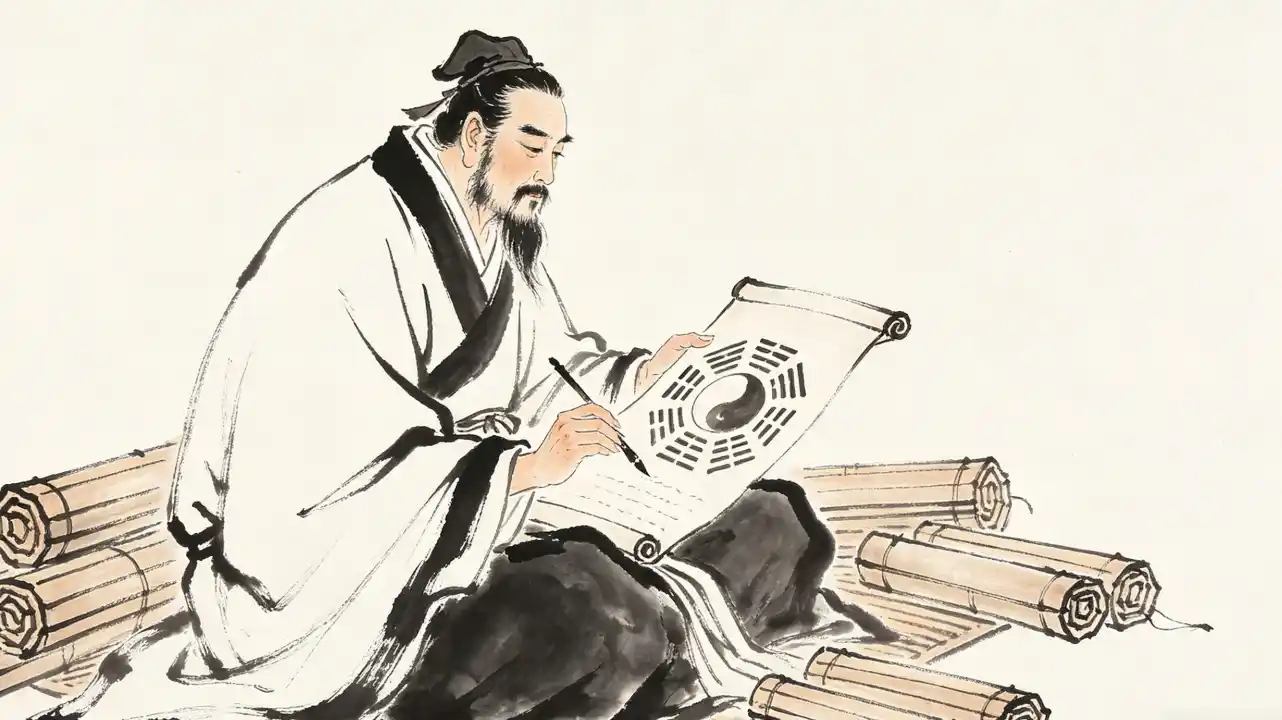
Confucius and I Ching: The Key Transformation from Divination to Philosophy
The encounter between Confucius and the I Ching was a milestone event in Chinese intellectual history. This relationship can be divided into three stages, completing a fundamental philosophical transformation. First Stage: Late-Life Intellectual Turn According to the Records of the Grand Historian, Confucius developed a strong interest in the I Ching in his later years, expressing “If I could have a few more years, studying the I Ching at fifty, I could avoid major mistakes.” During this period, he studied the I Ching so intensively that he “wore out the leather bindings three times.”
Read More